How can SEO and automation work together? They work together through a clean division of labor. Software collects rankings, crawl data, and keyword signals at scale. People across the United States decide what to publish, what to fix, and what to prioritize first.
That split matters for U.S. businesses competing in crowded national search results. Manual review cannot keep pace with thousands of URLs or shifting search intent. Automation compresses the reporting cycle so teams spend their hours on revenue decisions instead of spreadsheet maintenance.
How Can SEO and Automation Work Together?
SEO automation pairs machine speed with human judgment. Systems gather and process signals continuously. Marketers interpret them and act. The result is faster problem detection and quicker execution across large U.S. websites.
Adoption is already mainstream. Stanford University's Institute for Human-Centered AI reported in its 2025 AI Index Report that 78% of organizations used AI in 2024, up from 55% the year before. Search teams sit squarely inside that shift.
Can Keyword Research Be Automated?
Yes. Discovery, clustering, volume pulls, and intent labeling are all automatable. Software groups thousands of queries into topic clusters in minutes. What it cannot judge is which clusters actually match a U.S. business model and its margins.
Run this checklist before you scale data-driven keyword research and strategy:
- Confirm seed terms reflect how American customers phrase their problems.
- Cluster by intent, not by string similarity.
- Separate commercial queries from informational ones.
- Approve every cluster label with a human reviewer.
- Map one cluster to one page so pages never compete.
How Can Automation Help With SEO Content Optimization?
Automation scores drafts against the entities, questions, and formats already ranking. It flags thin sections, missing subtopics, and weak internal links before anything publishes, which shortens editing cycles without lowering standards.
A dependable structure for this is the ACTS Loop: Audit, Connect, Trigger, Supervise. Audit pulls crawl and ranking data on a schedule. Connect joins that data to your CMS and analytics. Trigger fires alerts or drafts when thresholds break. Supervise puts a person on approval before anything ships.
Which SEO Tasks Can Be Automated?
Automation handles repeatable, rule-based work: crawling, rank tracking, log analysis, schema generation, internal link suggestions, redirect mapping, reporting, and alerting. Any task with a clear input, a clear rule, and a measurable output qualifies.
American firms are adopting these tools steadily. The U.S. Census Bureau working paper Tracking Firm Use of AI in Real Time found the AI use rate among U.S. firms rose from 3.7% to 5.4% between September 2023 and February 2024, with marketing automation among the most common applications reported.
The dividing line is judgment. If a task needs context about your customers, your margins, or your brand, it belongs to a person. If it needs consistency across thousands of rows, it belongs to a machine. That single test scales cleanly as a site grows.
Can You Automate Internal Linking?
Yes, within limits. Rules-based systems suggest links by matching topic clusters, anchor variants, and page authority. They surface orphan pages fast and keep large U.S. catalogs connected as inventory changes.
Expert tip: cap automated internal links at a fixed number per page, and require human approval for any link pointing to a revenue page. Unsupervised linking dilutes anchor relevance and buries the pages you most want ranked.
How Can Automation Monitor Rankings and Organic Traffic?
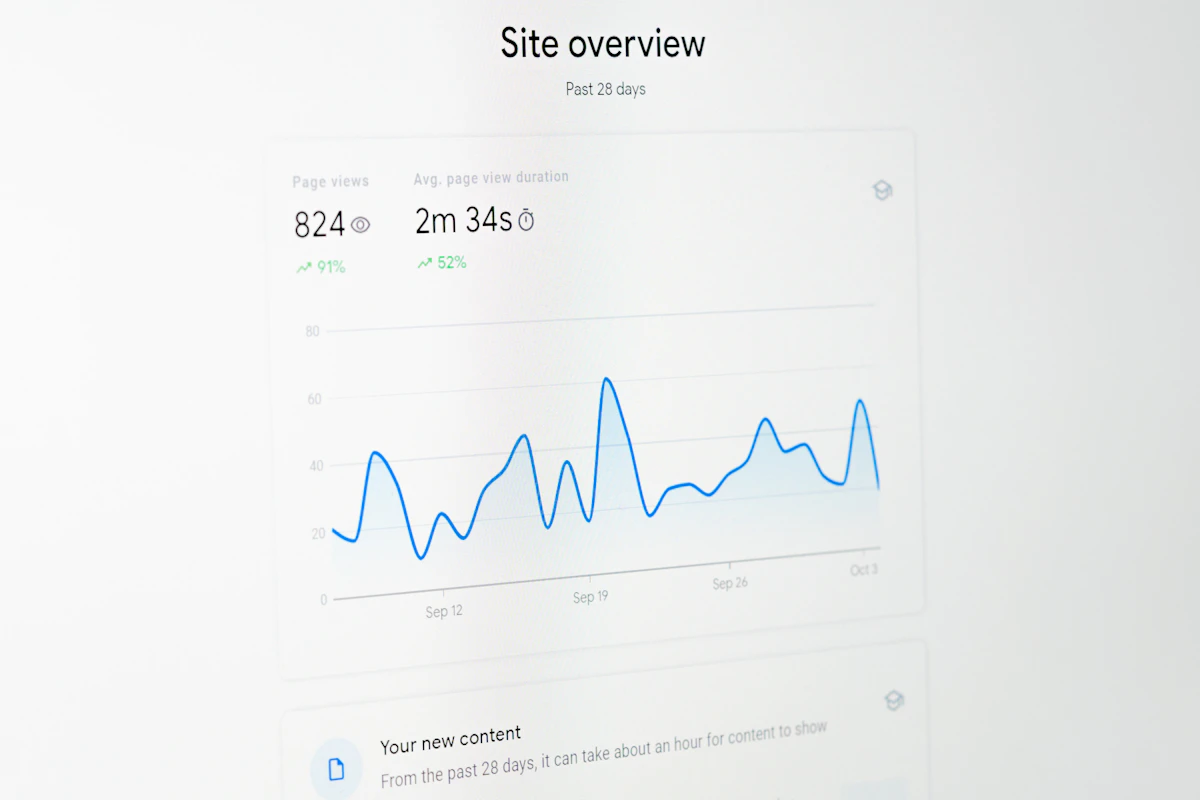
Scheduled tracking watches positions, impressions, clicks, and index coverage daily, then alerts you when a metric breaks its threshold. Weekly manual checks miss the window when a drop is still cheap to reverse.
Consider a U.S. equipment supplier with 4,000 product URLs. The team set alerts for any page losing more than five positions in a week. Within a month, the alert exposed a template change that had stripped headings from 300 pages. Automation found it. A person diagnosed and fixed it.
Can Automation Improve Technical SEO and Website Performance?
Yes. Automated crawlers detect broken links, redirect chains, duplicate titles, missing canonicals, and slow templates continuously instead of quarterly. Continuous detection shortens the gap between a defect appearing and a developer resolving it.
Google Search Central documentation confirms that Interaction to Next Paint replaced First Input Delay as a Core Web Vital in March 2024. Automated performance monitoring keeps U.S. sites measured against the current responsiveness metric rather than a retired one.
Speed compounds here. A site that resolves template defects in days instead of quarters recovers crawl efficiency sooner, which means new and updated pages get discovered and evaluated faster across the whole domain.
Can Technical SEO Audits Be Automated?
Most of an audit can run on a schedule. Crawlers compare each snapshot to the last and surface only what changed, which turns a heavy quarterly project into a short weekly review.
Sustained technical SEO optimization depends on that rhythm. Site speed, mobile rendering, crawl budget, and index status all drift as sites grow. Scheduled checks catch drift while it is still a small fix.
How Can Automation Help Identify and Fix SEO Issues?
Detection and remediation are different jobs. Automation excels at detection: it scores severity, groups issues by template, and routes tickets to the right owner without anyone reading a crawl export line by line.
Remediation stays partly manual. A system can regenerate missing meta descriptions or apply a redirect rule safely. Rewriting a page that lost an intent match, or restructuring a category tree, requires someone who understands the business behind the URLs.
What Are the Benefits and Risks of SEO Automation?

The benefit is speed and coverage. The risk is on an unsupervised scale. Automated systems repeat errors as efficiently as they repeat wins, so guardrails decide whether automation compounds value or compounds damage.
Governance is now formalized. The National Institute of Standards and Technology released its Generative AI Profile on July 26, 2024, extending its AI Risk Management Framework with practices for governing generative systems. U.S. teams that apply the same discipline to search workflows publish with far more confidence.
Ownership is the practical safeguard. Every automated workflow needs a named owner, a documented rule, and a fixed review interval. Without those three, automation drifts quietly until someone notices traffic that has already gone.
Should You Use AI to Automate SEO Content?
Use it for structure, research synthesis, and formatting at speed. Strong AI content optimization makes pages easier for search engines and answer engines to parse, cite, and recommend.
Keep a human on accuracy. Every claim, figure, and product detail needs verification before publication. Volume without editorial control produces pages that rank briefly, then lose trust with both readers and search systems.
Which SEO Tasks Still Require Human Expertise?
Strategy, positioning, and prioritization stay human. Deciding which market to enter, which offer to lead with, and which pages deserve investment requires context no crawler holds.
Relationship work also stays human. Earning authoritative mentions, interviewing subject experts, and building original data assets depend on trust. Those are the inputs that separate a U.S. brand from every automated site chasing the same terms.
Frequently Asked Questions
How long does SEO automation take to show results?
Reporting and monitoring benefits appear immediately, often within the first week of setup. Ranking and traffic gains follow standard SEO timelines, since automation accelerates detection and execution rather than shortening how long search engines take to reassess pages.
How much does SEO automation cost?
Cost depends on site size, the number of tracked keywords, tool licensing, and how many workflows you build. A small brochure site needs far less than a national catalog with thousands of URLs and multiple content owners.
What should you avoid when automating SEO?
Avoid publishing anything without human review, applying redirect or canonical rules sitewide untested, and mass-generating pages with no unique value. Each mistake scales instantly, which makes recovery slower and more expensive than the time review would have cost.
What is the first step to automate SEO?
Start with an inventory. Crawl the site, list every recurring manual task, and mark which ones have clear rules and measurable outputs. Automate the highest-frequency, lowest-judgment tasks first, then expand once the outputs prove reliable.
Conclusion
SEO and automation work best as partners. Automation delivers coverage, speed, and constant monitoring across large U.S. websites. People supply strategy, judgment, and accountability. Teams that respect the boundary between the two move faster without trading away quality or trust.
Nexvato brings that balance to businesses across the United States through SEO Management and AI Agents and Assistants, covering keyword research and strategy, technical SEO optimization, AI content optimization, and intelligent automation under one dedicated team. Get your free SEO audit or schedule a consultation to map your next step.